


I really like folk music, and Stan Rogers' music specifically has such unique and beautiful themes and tones that I can't help but feel a bit caught up in it all. Stan sings mostly about martime life in Nova Scotia and the struggles of a changing world, but his music does not shy away from other aspects of folk music such as farm life, poverty, and the endless grind of labor. Below I will write a bit about each of his songs that I really like, but Stan as a person seemed like a really cool guy. As I am doing research to write this, I found out that he died at 33 from a fire in a plane which is incredibly tragic. Cut down in his prime, the world will never again see a man like Stan Rogers. What a shame...
The subdued, and gentle instrumentals really give off a sense of something lost. Yes, there is a tagedy here, but it's not a sudden and violent one, instead it is the slow death of a way of life. Now a days, only the older fishermen, too tied to this place to let it go are willing to keep their traditions alive. Stan's vocals pair well with the intrumentals to sound like an old man reminiscing on what once was, and I especially like the strings in this. They just emphasize the idea of heartbreak for me, such deep and sombre notes feel like they come right from my chest.
Free in the Harbour takes almost the extact opposite approach as Make and Break Harbour does when talking about a dying fishing town. Before the mood was sombre, and mournful. We are watching a culture die, and it takes the perspective of an old fisherman watching it all happen around him. But this song is a lot more upbeat, with swelling instrumentals, as Stan sings about almost the exact same themes. One interesting aspect is that Free in the Harbour flips the perspective to that of the whales, specifically Blackfish (orcas) on the west coast of Canada. The whales to me feel like an analogy for the rest of society in that they don't care about the town, they just keep going on as they always have. Something else I really enjoy about this song is how he characteriszes the young men who leave their homes as naive or immature. These guys are bragging about the pay their going to get as they turn away 300 years of family history and let their hometown turn into dust.
This song is about farming and the poverty associated with it, and I think this is really interesting in today's day and age because so much has changed over decades of constantly pushing out the poorest and smallest farms. The song paints this picture of a small family farm that every year puts a ton of money into the crops, hoping that maybe this year they will get enough money to pay off all the loans. It's a very real feeling, the idea of being tied to the land, and being almost powerless in a world that demands value while trying to pay you as little as possible. I love this song, and I think the vocals do a great job showing how economically risky farming is (was). But what I think is even more interesting is that farming today doesn't look like this anymore. Most farming is a much larger scale, dealing with government buyouts for bad crop years, and lobbying to politicians. This song shows an industry at a completely different point in time and it is wretched to think about how many farms like the one in this song were pushed into cities by how the industry has evolved over time.
Bluenose is one of those songs where Stan just sings poetry at you and it fucking slaps. This song holds a lot of the same themes as the Free in the Harbour and Make and Break Harbour, but I really like how he talks about the work and joy he feels when he's sailing on one of those older fishing boats. He also does the classic sailor thing of personifying the boat, but I thought it was unique how he describes the boat as something that flies and a vague "living thing" as opposed to a person. It makes the boat feel more like an animal or some wild beast, which I imagine is more accurate to how sailing a large boat is.
The Idiot is a song about leaving home in search of work and the thoughts associated with such big decisions. The central theme of the song focusing around the choice being idiotic because protagonist misses so many things about his home. I think this song pairs really well with a song like Free in the Harbour, because Stan is able to give the perspectives of both the young and old as they move through a changing world. On one hand, the protagonist in The Idiot wants to be free, not tied down to a dying town where he knows that he would have to suffer through poverty. It's understandable that he would want to escape the harsh reality of rural life on the East Coast. But at the same time he holds onto the idea that he really hates life on the West Coast in the oil refineries. He sees no nature around him, the cities are dirty and he doesn't like cowboy clothes! The protagonist in The Idiot is being ironic when he calls himself an idiot, because he knows that he doesn't love the decision he made but he feels that he was forced into the choice. And this contrasts really well with Free in the Harbour where the older folks watch younger people leave, thinking of them as naive and childish, prioritizing money and comfort over traditions.
Unlike a lot of Stan's other songs, Workin' Joe feels kinda timeless. Stan died in the early '80s, so if I had to guess this song probably was written in the '70s, but the idea of being overworked and missing out on time you want to spend on family rings true today. This doubles up with some of the other ideas the song explores like realizing that he has more bills that he cannot keep up with as he goes through life. It's a bit jarring to hear Stan sing about such a normal mundane life, but I think it also gives it a bit more bite. I tend to associate Stan's voice with dramatic events, almost mythiologized in moments of sailing in a world that no longer exists. Crashing waves with intense imagery of tragic ship wrecks and naval battles. But even a man steeped in rich history gets ground down by a 9 to 5, goddamn that cuts.
The last song for this vague category of Stan Rogers songs that I want to write about is all about modern life and mirroring it onto the sailor mythos that Stan loves to sing about. For those unaware, work songs or shanties were super common on sailing boats as a way to boost moral and keep sailors in time for pulling up the rigging. This is of course not necessary for a white collar job like the one in the song. In fact, the entire song is about how monotenous and boring his job and life is. In some ways it feels like a cry for help, but I can't help but see a bit of pride in the way Stan sings, as I'm sure sailors felt back in the day. "It's tough work, but such is the life of a sailor!" type energy. I also appreciate that there are back up singers in this song, it ties in the idea that these ideas aren't just one guy, but everyone wanting something different but being stuck in their work. I'm like 1000% sure that sailor had these same feelings when they signed contracts to work on boats for like 6 months.
I like the bait and switch this song does with what the lies are, and how the woman Stan is singing about views herself. Like a lot of his songs, Stan found a really specific but relateable feeling (I assume much more so for women as they get older) and pulls on your heartstrings as he explores the feeling. The protagonist of the song is an aging ranch wife who tells herself that she is ugly and it is tearing her apart inside. She is constantly looking at herself in the mirror and wishing that the mirror could tell her lies, so that she could see herself as she was instead of how she is now. But towards the end of the song, the woman goes to the legion (I am not Canadian, I imagine this as some sort of community event) with her husband who puts all of these thoughts to rest by calling her beautiful "line for line". And the song ends with "[he] laughs at how her mirror tells her lies". It's such a cute way to show how much love is shared between the two, and it feels like a very real way that people get over their insecurities.
Classic love song here, and honestly, it's pretty solid. Probably not my favorite Stan Rogers song but I appreciate how real it is. It doesn't pretend that the two characters are soul mates or fated to be together, it instead acknowledges that the woman had been married before and she feels like she doesn't want to try for love again. It paints love as a starting point in a relationship as opposed to the end point, and that these characters are allowed to grow as they move through time together. It absolutely breaks my heart to know that Stan never got those 45 years with his wife.
Holy shit, I fucking love this song. Stan Rogers almost never touched genres outside of the broadly folk category, but this and Night Guard lean into rock. The theme of the song is fine, I can understand the idea of having cabin fever and the first human interaction in months escalating into something out of control but I personally am not as moved by it compared to other songs of Stan's. Where this song really shines is in how Stan describes how the protagonist of the song feels from a third person perspective. My favorite part by far is how he describes the bar fight, "he's a bear in a blood red macanaw with hungry dogs at bay, and springtime thunder in his sudden roar". It just paints such a vivid picture of this wild almost heroic moment of a wild bear fending off hunters that would dare to challenge him. That plus Stan's vocals are just perfect, it really makes this song special in a stacked discography. I wish so badly that Stan kept exploring rock as a genre, because I'm not sure I will ever find another song quite like this one.
This one's a tad similar to Canol Road in that Stan is exploring rock as a genre, but it's got a slower tempo (might be the wrong word), and is generally lower energy. It fits well with the theme of the song, though as the protagonist is an aging rancher who got his money from rodeo riding. It's a real rags to slightly less rags story, but he's dealing with cattle ranglers now and it's breaking the bank. The song doesn't really reach a satifying ending to me, other than that he staked out the farm and got a license plate of the thieves. Maybe I just don't understand the ending, but not even the Genius geniuses have an answer, so it is what it is. The song's a bop, just doesn't have much to say.
Have you ever read stuff from like Plato, and they're just like "If this guy sucks just kill him!"? I find it kinda wild because like killing someone is such a big deal and has been for quite a while. When I first heard this song, the young guy falling overboard and dying hit me like a fucking truck, and to be fair it's exactly what Stan was going for. It so well written to show how the old man we see the story through wanted so hard to safe the kid, but failed and had to watch as the boat kept going. Flashing back to the young man's future wife in the chorus also hits pretty hard, and just really humanizes the character in a way that not a ton of media can accomplish. The instrumentals are also amazing in White Squall, and somehow tie together the upbeat tempo with the devastating themes.
I actually hadn't heard this one until fairly recently, and I'm happy to say that Stan Rogers never ceases to bang out the tunes. Occasionally in a song he'll use a deeper voice that just has so much character like he does in Acadian Sturday Night, but I haven't really seen in for an extended period until now. Giant is a tad on the longer side and can definitely get a bit repetitive, but oh man that chorus. "Crash the glass down!" will live on in my head forever, it has such an infectous energy of dancing around a bonfire and celebrating rites and rituals. I might have more to say about this song as I hear it more and more, but right off the bat, I cannot get enough. Fingal will rise!
Maid on the Shore is all about sirens, but never expressly says it. It plays around with the idea of luring sailors in, but instead she only enraptures the captain. Instead of killing the sailors, she only steals their gold. Instead of protraying her as a monster that could fight, she escapes on a dingy and stole the captain's sword. It makes the ordeal feel more risky for the maid, but also like a heist. She knows the risk, but she's done this before and will do it again. It's a refreshing take on sirens as more human than monster, and I like that her motives are selfish and greedy rather than outright evil. Afterall, it's to her benefit that these chumps go back out there and collect some more gold for her...
This song is actually a cover, and while Stan typically wrote his own stuff, he's done a few other covers. There's also a follow up song to it, but the vibe is totally different. Archie Fisher wrote the original and the sequel called "The Return". Anyways, this song has a prophesy vibe and feels a tad like tavern music for a midevil video game. Which makes sense, because the song was written in the mid '70s for renaissance fairs. Anyways, it tells the story of a wounded knight seeking the aid of a witch and his journey through the lands as he gets to her. I wish I had more to say about the song because I like it a lot, but I think it speaks for itself.
The previous folksy songs focused mostly on mythos or folk lore, but folk music is not always about the tall tales or monsters of old. Sometimes, folk is about just that: folks, and I love the idyllic rural life Watching the Apples Grow paints. Stan sings about the mountains near the sea, the wildlife, and the family he wishes to be back with, and he contrasts it with the city of Toronto, where all of this seems so far away. I'd say that it feels a bit like The Idiot in its themes, but Watching the Apples Grow seems so much more hopeful and stubborn in that nothing would take the protagonist from the life he wants by the sea. No mention of sailing or money, he knows he loves this place and would be damned if he had to live anywhere else.
What a freaking game man. My experience with Hollow Knight started with late middle school me back in 2017 fucking around on the Nintendo E-shop on my brand spanking new Nintendo Switch (thanks to my fat stacks of Bar-Mitzvah money). Me with my mobile gaming brain was so apalled by $60 games (I'm sure this will age like milk) that when I saw a cool looking game for $20 (very real possiblity it was $15) I just had to jump on it. And holy shit man for $20 this game is amazing. I'm not even the biggest fan of difficult games, I assure you I am no Dark Souls forged mega-gamer beating Elden Ring bosses while drunk. And likewise, I got my ass HANDED to me by this game. Many, many, many times. So many times in fact that I left this game before getting the true ending. Something about the combination of difficult platforming and extremly precise boss fights made it really tough for me to make consistent progress, but I just loved exploring through the world that it made every 2 hour slog through a boss so worth while. I remember so often getting absolutely walled by a boss, and spending hours just reading about all the different upgrades and things I could do to make the bosses easier. It was so humbling, but I think instilled in me a very real sense of things greater than me as the player. Why would I care about slogging through the boss fight when all I want to do is explore and it'll make the boss easier? It also just fundamentally shaped how I saw the game (I will talk about this again with Silksong), because I feel like I got a lot more of the lore and little details than I would have if I tried to brute force my way through the game. It's a feeling a lot of souls-borne gamers get where they learn all the best routes and shortcuts to help them on their nth replay of the game. I never actually replayed Hollow Knight despite holding it so dearly, mainly because I don't think I can ever put myself back into the headspace I was in the first time around. There is something so unique and valueable in not knowing where everything leads that to me a replay would not hold the same signifigance.
It is hard to put into words how this game made me feel. For years Silksong felt like this nebulus thing that wasn't quite dead but wasn't quite alive either. I don't think anyone was surprized that it came out, but more shocked that is was finally here. Kinda like a balloon popping. And me personally, I have never been around for a moment like this where thousands of fans are finally after years of waiting get their sequel. In the vein of Half Life or Baldur's Gate, it has always been a bit interesting from an outsiders perspective, but being in it was a whole different thing. I would say it felt like seeing an old friend, and catching up over all the things that have changed in the time you last saw them. And on that note I want to talk about the things I love in this game!!!
Number 1: I might get some hate for this, but I really liked the mechanic where some enemies could do 2 masks of damage instead of 1. Did this make my life a lot more miserable? Yes. BUT! I like this for how it changes how you see the world. I am much more likely to run past a guy who only takes 1 mask than I am a guy who might hit me and take 2. Because of this, I had to think a lot more than I did in Hollow Knight about how I would approach certain enemies. And just to add to this, I LOVE that healing is much more of a gamble. In Hollow Knight, I was constantly getting hit because there was more wiggle room in the player's health bar which forced the bosses to give you less space to avoid attacks. This meant that I was constantly healing during boss fights, because healing was quick and I was likely to take damage again soon. In Silksong, they made it more problematic to get hit, but there is more space between hits. This means that you can back off and get some space to heal and do that more infrequently compared to Hollow Knight where I was unable to get away from the bosses and forced to heal at the same time as dodging. The caveat to all of this is that I would die so often while trying to heal and this was very punishing feeling. Not in bad way (to me at least) but definitely required me to do a bit more thinking.
Number 2: I think the new charm/crest system works great and grealty expands on the original concept. In Hollow Knight, you had X amount of spots and each charm cost Y spots. You could mix and match and sometimes they synergize to give a better effect. This made it so that you could fight bosses in different styles. For example, I could equip a bunch of charms that make my spells really good or I could make the nail super long and both a valid ways of beating a boss. Silksong expanded on this by adding crests. These basically have an ability (get more silk from enemies, hitting enemies heals you, do more damage if you don't get hit, etc.), a different attack pattern (more damage but slower, short range but quick attacks, etc.), and can hold different ratios of 3 different types of charms: red, blue and yellow. Red charms are tools that you can use like an attack, blue and yellow charms are passive items with blue charms being more focused on combat and yellow charms being focused on you. This system forces you to compromise a lot more, and makes charm combos a lot more significant when you find them. I could talk forever about the tools and how much I love this sytems but I hope I got the point across. Super cool improvement on an laready great game mechanic!
Number 3: There is simply no talking about Silksong without talking about the bosses. They are 10/10 chef's kiss with the occasional dud. It's ridiculously easy to find people on the internet complaining about literally every boss, but I think most of these people (myself included) will find that they love most of these bosses if they came back to them or gave themselves some space from the game. There were only a couple that felt super unfair, but even these were enjoyable in that I was forced to try just about anything I could to get through them just like I had to with Hollow Knight. My personal 2 favorite bosses were the Cogwork Dancers and Crust King Khann, probably because my favorite boss in Hollow Knight was the Mantis Lords (NOT THE TRAITOR LORD FUCK THAT GUY). I was however very dissapointed in the Clover Dancer fight, simply because of how short it was. Not that it absolutely needed to be "better" just my 2 cents.
Nut trees are cool for plenty of reasons (as I will describe below), but just in general these guys are a super cool way to rethink about agriculture and food systems. These guys give me hope that there are ways to more sustainably live off farming and I am excited to share that with you!
Hazelnuts are interesting for a few reasons:
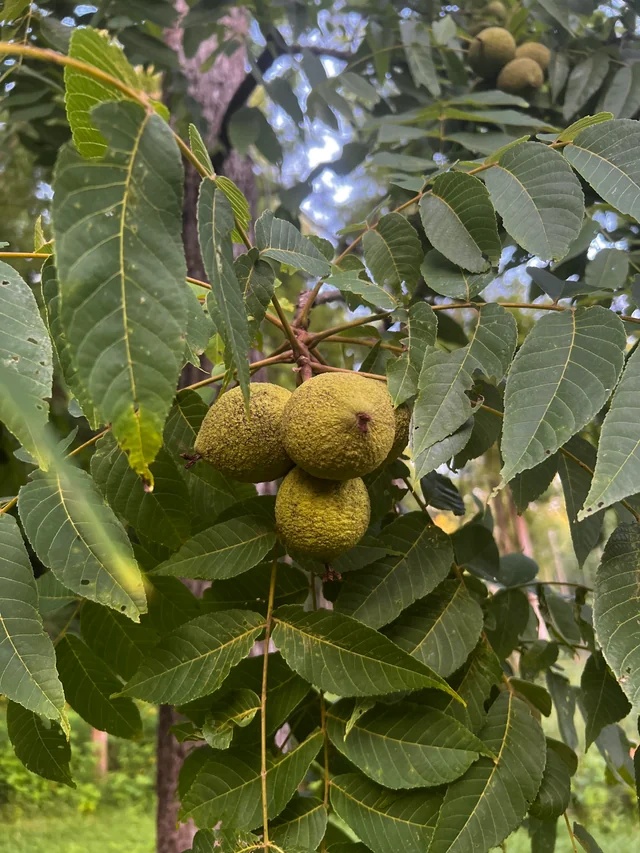
Black Walnut is one of those trees that you'll see about a bajillion youtube videos on about foraging, and how easy it is to collect a bunch of them. While this is cool to me, I find several other aspects of this tree much more interesting than just the food.
Hickories are cool in part because there are so many different types of them that they can cover a lot more ground. Bitternut or yellowbud hickories produce a nut that is so full of oil that you can feel it on your hands if you pick one up. These nuts are also filled with so many tannins that no animal dares to eat them. Why would I want a nut filled with bitter oil in it you might ask? Well, the cool part about tannins is that they are water soluable, not fat soluable. This means that if you were to press the oil from these nuts, you would get an oil that tastes like hickory smoke and not the tannins. Like Hazelnut oil, Bitternut hickory oil is also high in polyunsaturated fat and has a high smoke point. Easy harvest + healthy oil = awesome tree!
Another cool hickory is the Pecan, so cool in fact that the Southeast US has them planted everywhere! If you look online, you will see many stories about folks planting pecans back in the day and then people buying property only to find out there are 200 year old Pecan trees that produce 100+ pounds of nuts a year! I'm fairly certain the oil from Pecans is similar to Bitternut as well, though I am not the most knowledgeable in this front. Pecans are unfortunately more warmth loving, so I think I will likely never have a tree of my own ): .
The last hickory I will write about is the Shagbark hickory. First of all, look up a photo of these guys. Right now. Do it and then come back. Aren't they just so pretty? These guys are super drought tolerant due to their enormous tap roots, but have a slow growth rate. The bark can be used to give a smokey flavor to grilled foods, and one article I found write about a Native American technique to make a syrup from the bark (Slow Food Foundation). The nuts are of course edible, and are great for wildlife if you don't get the chance to harvest yourself!
Chestnuts like Hazelnuts are one of these species that people get really excited about. They see a market for it, and thus a way to bring a more sustainable form of agriculture into the mainstream. My only problem with Chestnuts is that I don't really see what the hype is about. Like I totally get that the hybrud trees can put out a lot of nuts in a single year, and I also get that you can make a lot of money with these trees if you get high yeilds. What I don't get is what the end product is. I've seen Chestnut flours get talked about, and people will say that eating the whole nut is tasty (I'm sure it is), but to me these don't really address a gap in the market. I'd like to see Chestnuts do something that no one else can do. I think some people see this already and are trying to make new products with Chestnuts which is cool, but I think it might be best to wait it out and see if Chestnuts can show their merit in a new and unique way (at least for the US market). Otherwise, these guys rock! Hybrid trees can produce nuts in 3-5 years and larger harvests in 7-10 years. They have some natural spiky protection of their nuts from squirrels, and they grow best in sloping, acidic soils which tend to not be great for most agriculture.
I will begrudglingly admit that Beech is cool. I don't have anything against Beech, but compared to all the other guys on this page, it's hard to compare. Beech does have a lot of wildlife value, especially for Black Bears which is actually awesome, but the wood is worth very little, and the nuts are quite small. If I were to put a tree onto a landscape, I think I would want something that will do a bit more than what a Beech does. With that said, I would love to have my mind changed on Beech. Imagine if a masting tree with suckering roots did something cool? Now THAT I would get excited about!
[I am not talking about Oaks, because while I do think they are cooler than Beeches, I have mostly similar thoughts on them. I do NOT want to hear about acorn flour, I don't think that's going to be a thing.]